My harmonica gear
Örjan Hansson
- Web site: https://ohw.se, E-mail: harpoh (at) ohw.se
- Page last updated: 2026-05-28
- Web location: https://ohw.se/hca/gear/
On this page I describe the harmonica gear that I use.
There are also some items that I’m not using anymore.
My favorite harmonicas and my harmonica case
I mainly use Hohner Big River MS harps that I modify and tune myself. I like the MS (Modular System) concept that allows one to easily replace parts of the harmonica or switch parts between different types of MS harmonicas. I think the Big River sounds like the classic Marine Band, which I believe is due to the similar design of the cover plates. In addition, an MS harp is slightly larger than a Marine Band, which suits me better.
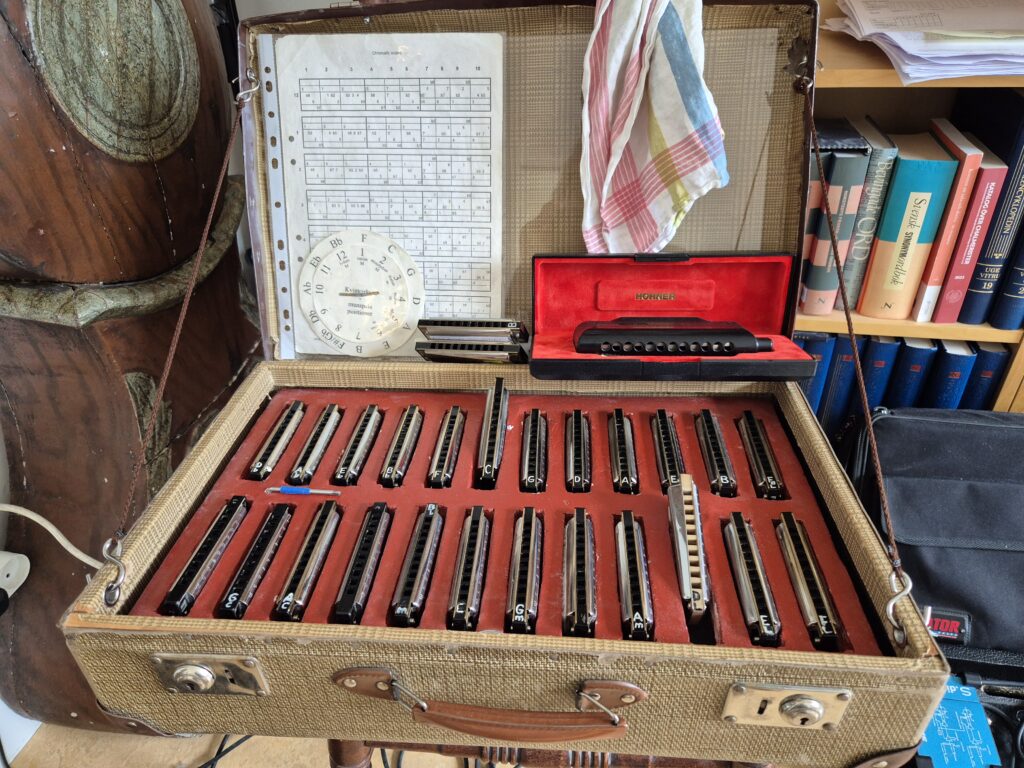
To the right is my harmonica case modified from a vintage briefcase. I use a kind of flat polystyrene (painted red) in which I’ve cut slots for the harps. In the upper row there is a complete set of Big Rivers ranging from low F# to high F, but organized according to an “open” Circle of Fifth.
Right-click on figure and select “Open in a new tab”
In the bottom row there are four harps at left in country tuning: F-low-ct, G-ct, A-ct and C-ct (the first and last are Lee Oskar, the others are Big River). Then there are five in natural-minor tuning: Bb-nm, C-nm , G-nm , D-nm and A-nm (labeled in first position) and finally three in low tuning: D-low (Suzuki Manji), E-low and F-low.
To the left in the lid, there is an example of how one can pair different harps with the help of velcro straps. Then it is easy to switch quickly between the two during playing.
To the right, there is a Hohner 12-hole CX12 (low C) that I like a lot – although I’m a rookie on chromatics.
Sometimes a reed can become so much out of tune (due to metal fatigue) that it can’t be retuned and then I replace the whole reed plate. I use MS brass reed plates (0.9 mm) that I buy from Hohner Spareparts.
For the tuning, I use a so-called 19-limit just intonation, see my page Practice of harmonica tuning.
My present microphones and pedal board
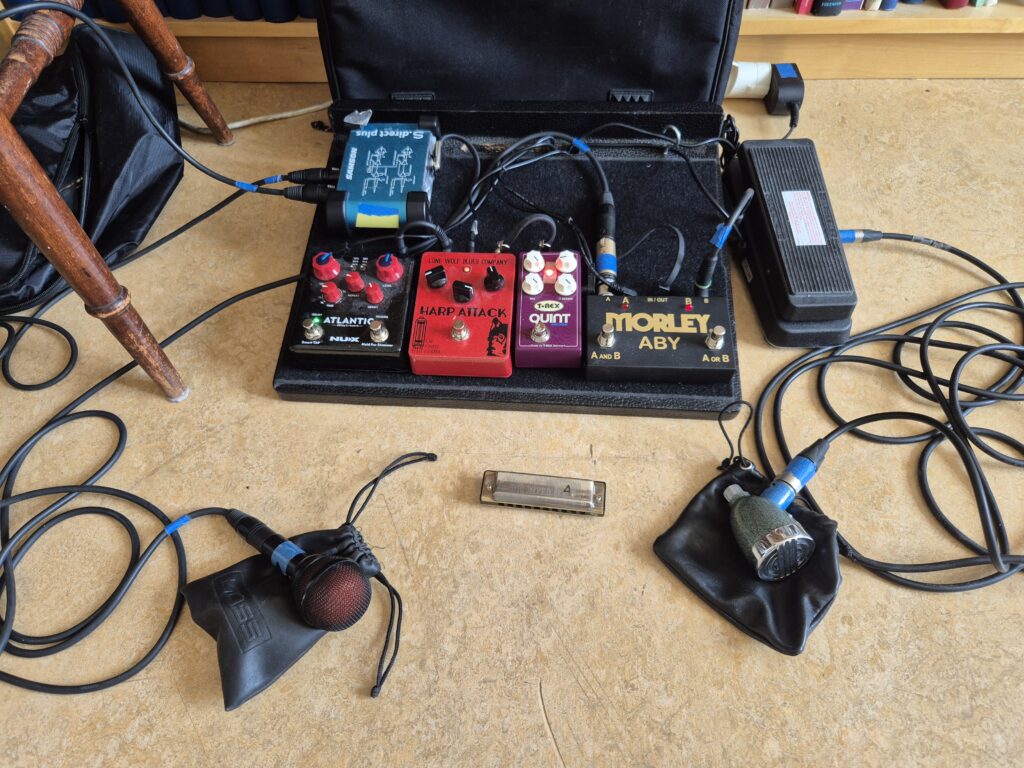
Currently I use two microphones (see figure at the right).
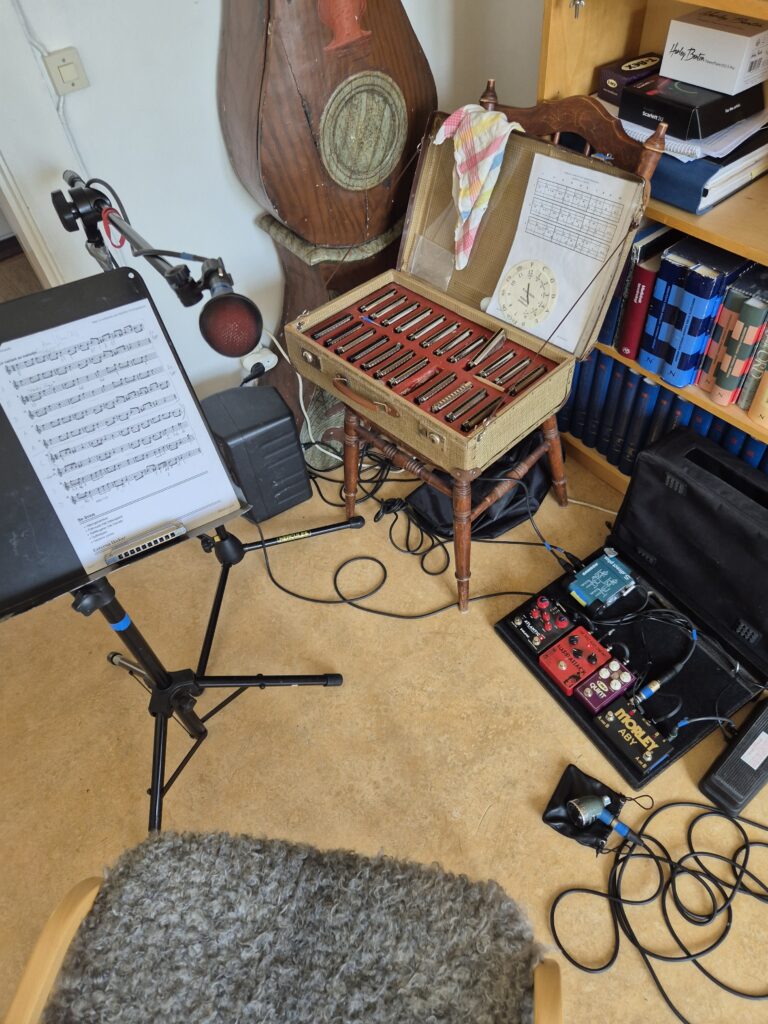
- Bottom left: Audix Fireball-V (low impedance, RCA connector) which I use “hands-free” mounted on a microphone stand (see figure at the top of the page).
- Bottom right: Hohner/sE Harp Blaster HB52 (high impedance, RCA connector) which I cup in my hands.
For a long time I’ve used various tube amplifiers (see next section). But due to pain in the back, I decided to try various pedals hooked up to small speakers or PA systems instead of heavy tube amps. I’m quite satisfied with the present pedal board, which I now shall describe.
- Selection of microphone.
- The Fireball is connected to the A-channel of a Morley ABY switch pedal via a small Shure A85F transformer (low- to high-impedance).
This transformer is more sturdy than the Audix T-50 K that I used before. That one came with a cable that is prone to short circuit. - The HB52 is connected to the B-channel of the ABY switch via an optional Cry Baby wha pedal.
- The Fireball is connected to the A-channel of a Morley ABY switch pedal via a small Shure A85F transformer (low- to high-impedance).
- From the ABY switch the signal goes to a T-Rex Quint Machine (purple with white knobs) which gives three different tones – an octave up, an octave down and a 5th up. Each tone can be adjusted individually and also be mixed with the other tones and the input signal.
- From the Quint Machine the signal goes to a Lone Wolf Blues Harp Attack drive pedal (red with black knobs).
With the Fireball I use a high Volume and a small Drive and the other way around with the HB52. As for the Tone, I usually set it at 11 o’clock.
- Next, the signal goes to a Nux Atlantic Delay & Reverb combined in one pedal (black with read knobs). The Reverb is used with the Fireball, usually with both Level and Decay set at 12 o’clock. The Delay is mostly used with the HB52 and with settings Level 12 o’clock, Repeat 10 o’clock and Time 1/4.
- Finally, the signal from the Delay & Reverb high-impedance output is transformed by a Samson S-directplus DI-box (blue) to a low-impedance output for further delivery to a PA system or a sound card.
Most of the pedals are powered with 9 V-DC from a Harley Benton PowerPlant ISO-5 Pro power supply (mounted underneath the pedal board), with some exceptions:
- The Harp Attack drive is powered with 18 V-DC, also from the Harley Benton power supply.
- The DI-box is driven with phantom power from a PA, from a sound card or from a 9 V-battery.
The pedal board and –tote (= carrier) are from Gator Cases.
My recording equipment
For recording, the signal from the Samson DI-box is sent to a Focusrite Scarlett 2i2 4th Generation external sound card (the red box in the figure to the right). This is connected with an USB-C cable to my computer – a Microsoft Surface Pro 10 with Windows 11.
As can be seen on the computer screen, there is a black window with which one can control the 2i2 sound card. The 2i2 has corresponding physical control knobs that also can be used. The 2i2 can handle two separate signals (for example stereo signals), but I’m only using one (mono).
For recording audio only, I use the free, open-source software Audacity. The sound from the 2i2 is fed into Audacity and then I can edit the file and convert it to various formats, mp3 for example.
When recording videos, I use the program Camera that comes with Windows. With this I can catch the sound from
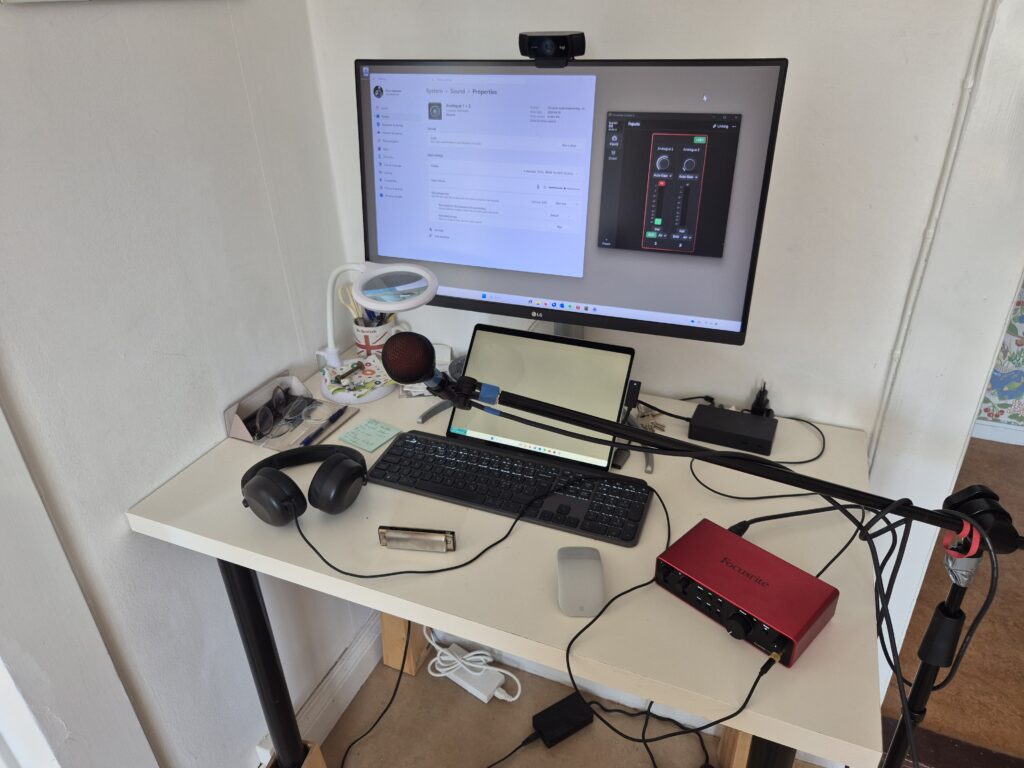
the 2i2 together with the film from a Logitech C922 Pro Stream Webcam mounted on top of the large computer screen. With Microsoft Clipchamp, also bundled with Windows, I can then edit the video and export it to mp4, or other formats. See the page Solo 2026 for an example
My previously used amplifiers
Analogue amplifiers
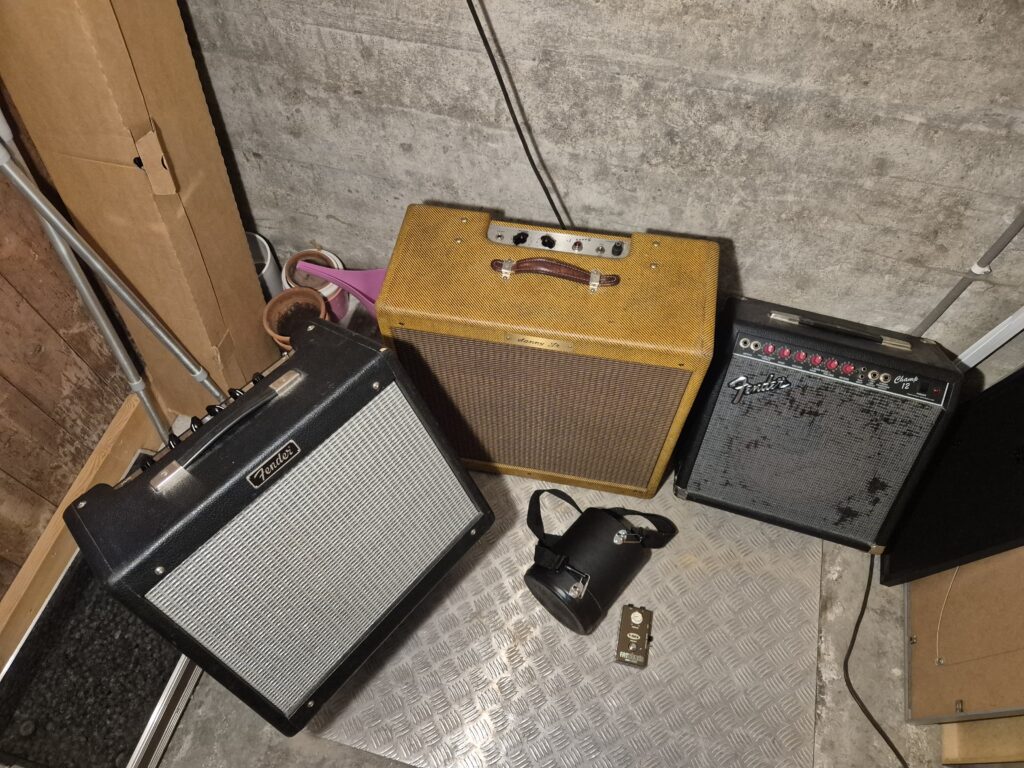
The figure to the right shows the “non-digital” amplifiers that I own at present. Below they are described in chronological order of purchase.
Fender Champ 12 (black at right, with red knobs). Designed in 1986. Bought in 1998 and used until 2000.
The amp generated quite a lot of feedback when using a Shure Green Bullet or an Astatic JT30VC and I had problems to get enough volume when playing in bands. After a while I put it away and replaced it with a Fender Blues Jr, see below.
In 2025 I tried the amp again and brought it out from my storage room. However, now the amp didn’t work at all. According to two separate amplifier technicians, the input transformer was severely damaged and neither of these guys could find a substitute.
This is sad, because the Fender Champ 12 has a historical value and I shall explain why. It is known that Leo Fender and his company started to produce guitars and tube amps around 1945. In the mid 1950:s, these had become very popular, for example the Bassman and the Tremolux. However, probably because of illness, Leo Fender sold the Fender company to CBS in 1965.
CBS changed the strategy towards modern technology, in particular solid-state transistors instead of tube amplifiers. At first, these became very popular, but more and more musicians were missing the characteristic distorted sound from tube amps. Of course, there were also other reasons for the increased financial problems. In any case, in 1985 CBS sold the musical-instruments part of the company to a group of investors.
The new Fender Musical Instruments had a plan to reduce the production of solid-state amps and go back to tube amps. They started in 1986 with the Champ 12, which was the first amp after the take-over that only used tubes (except for a transistor in the reverb circuit). In order to mark the new era, the new amps were initially equipped with red knobs and the Champ 12 was the first to have them. [John Morrish (1995), The Fender Amp Book, Balafon Books, UK]
Technical data: The Champ 12 had initially two double triodes (12AX7) for pre-amplification and a pentode (6L6GC) power amp for the output (10 Watts) to a 12″ Fender speaker. I replaced the first 12AX7 (internal gain = mu = 100) with a 5751 (mu = 70) which lowered the volume and reduced the feedback to some extent. The amp weighs 13.6 kg.
Indeed, I would be very happy if I could get my Champ 12 up and running, now when I have some more knowledge about taming tube amps for blues harp. If only I could find a new input transformer!
Fender Blues Jr (black at left). Designed in 1998. Bought in 2000 and used until 2025.
This amp has been my working horse for 25 years but, as described in the previous Section, I prefer pedals nowadays since the tube amps are too heavy for me to carry along.
Technical data: The amp has three double triodes, two for pre-amp and one for phase inversion for the two output pentode tubes (EL84, 15 Watt) to a 12″ Fender “Gold Label” speaker. It weighs 14 kg.
Originally, all three triode tubes were 12AX7 which resulted in a quite hot output and a metallic sound. But I’ve followed the suggestions from Ron Holmes and others on the Internet and changed them to 12AY7, 12AX7 and 12AY7, respectively. With further advice from Bob Maglinte, I set the control knobs at 12 (Master), 3 (Volume), the others at 6-7 and the Fat switch OFF. This results in less gain, a smoother sound, less humming from the reverb and less feedback (especially with the Master knob at 12) when playing through a Hohner/SE HB 52 microphone with the volume at max.
Sonny Jr #1 (tweed in the middle of the figure). Designed in 1998. Bought in 2002 and used until 2017 ca.
This is the first version of a series of amplifiers designed by Gary “Sonny Jr.” Onofrio in New Haven, Connecticut and built by Tom Stankiewicz of Cotton Amps in Tolland, CT. Gary also designed a Sonny Jr #2 and a Sonny Jr 410, among others, which are very desirable. I bought the amp from Paul Alfredsson who acted as product endorsee for Gary.
Technical data
- Serial nr: 094
- Rectifier: 5U4GB
- Preamp: double triode (12AT7 recommended but other triodes are shipped with the amp)
- Inverter: double triode (12AU7 recommended)
- Power amps: two pentodes (6L6GC), output 20-22 Watts
- Speakers: four exclusive Sonny Jr 8″
- Control knobs: Volume and Tone
- Weight: 15 kg
My Sonny Jr #1 is very nice with a smooth sound, especially if one mic the speakers of the amp in a large venue, although heavy to carry along. After experimenting with the triodes, controls and microphone I ended up with: Preamp, 5751; Inverter, 12AU7; Volume, 8; Tone, 2; Hca mic, Astatic JT30VC close to max.
Very small home-built amp (black in front of the Sonny Jr #1). Bought in 2025.
(Not ready)
Digital amplifier
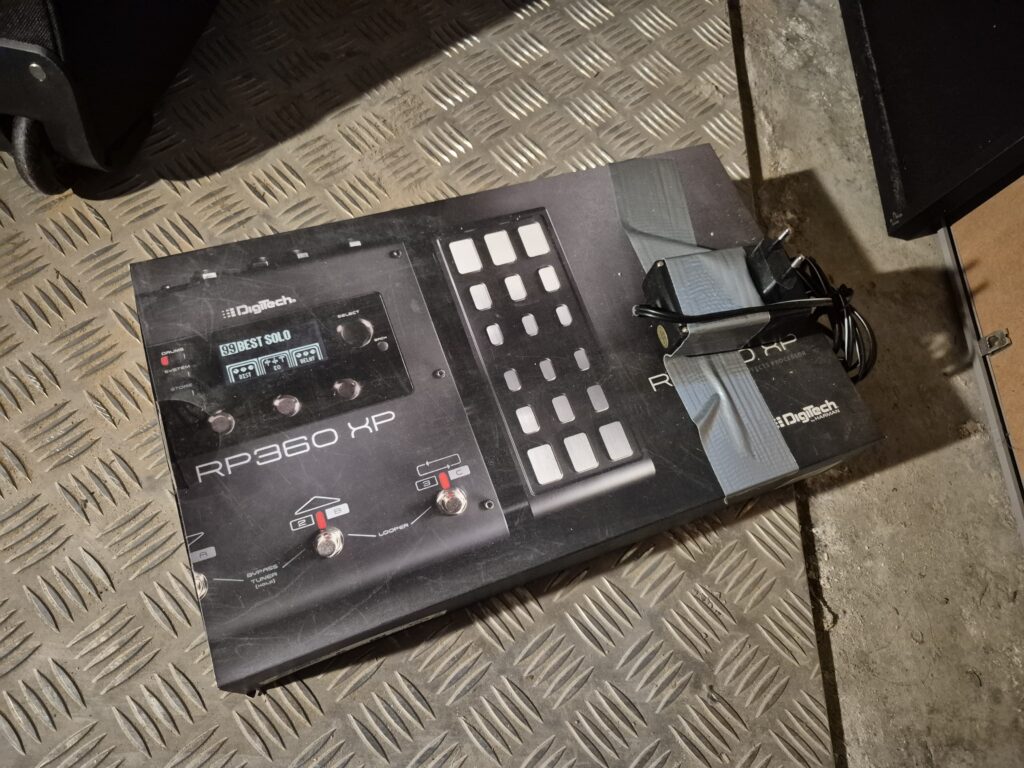
Digitech RP360 XP. Bought in 2015 and used until 2020.
This device can emulate the sound from many types of analogue amplifiers, including reverb, delay, octaves, equalizer, etc. It has high-impedance input and output and the latter can be delivered to a PA through a DI box.
Digitech has stopped updating the software which makes it difficult to use the RP360 XP.